WE'RE HIRING! Know how to braze? Join Premier Tooling Systems. Experience with torch or induction brazing preferred. APPLY NOW!
Cutting Tool Life: 7 Reasons Your Tools Wear Out Too Fast

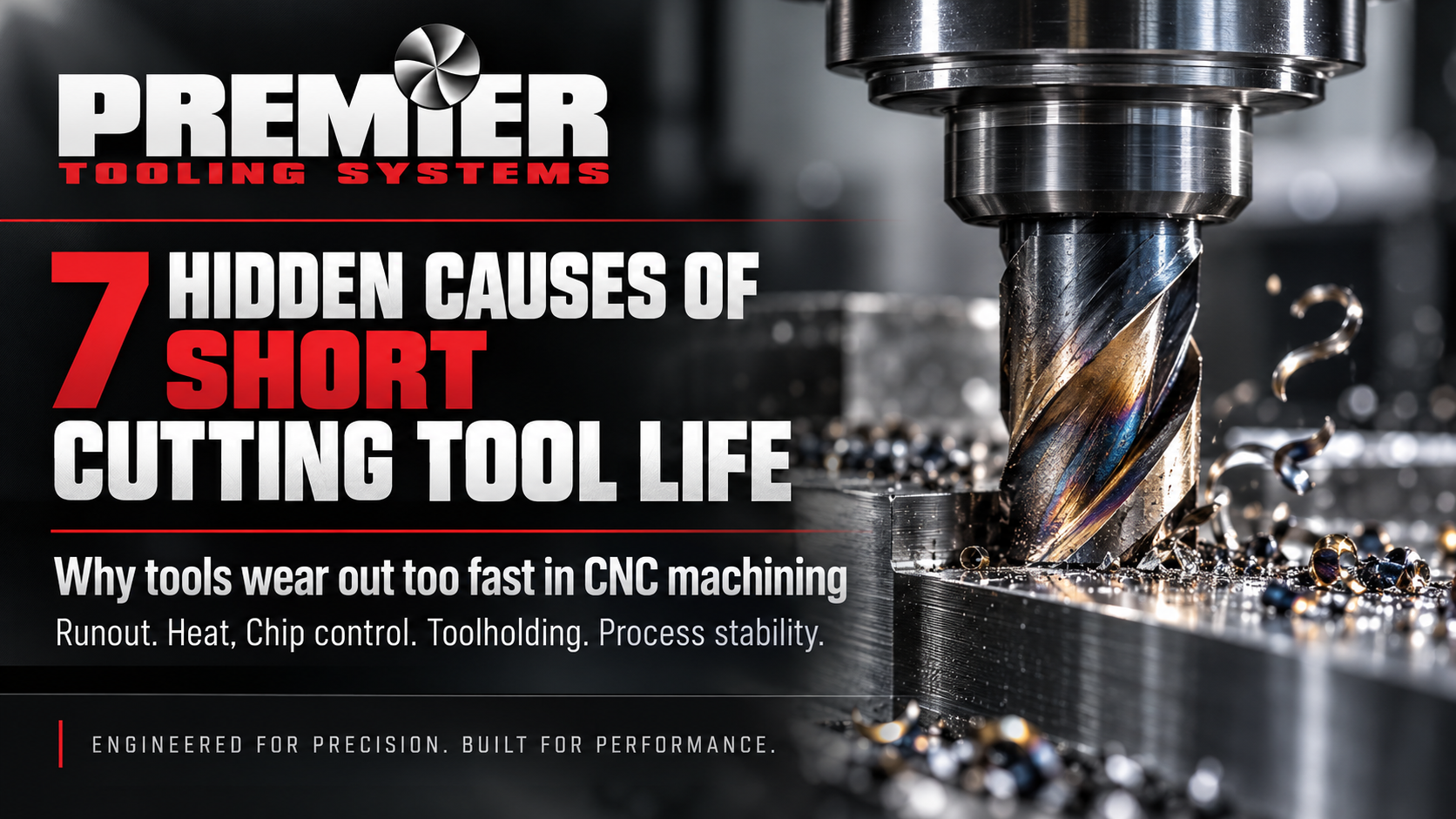
A cutting tool rarely fails for just one reason.
Sometimes the cutting speed is too aggressive. Sometimes the tool is running off-center. In other cases, poor chip evacuation, excessive tool overhang, vibration, heat, or an unstable holder gradually shortens cutting tool life long before the operator realizes there is a problem.
The result is familiar: more tool changes, inconsistent parts, unexpected downtime, and higher machining costs.
Research into cutting-tool wear shows that wear is influenced by a combination of temperature, pressure, friction, workpiece material, cutting conditions, and repeated mechanical loading. [ScienceDirect]
Before blaming the cutting tool itself, it is worth looking at the entire machining system.
What Determines Cutting Tool Life?
Cutting tool life is the usable machining time a tool can deliver before wear, damage, or loss of dimensional performance makes replacement or reconditioning necessary.
Tool life is not simply a property of the insert, drill, reamer, or end mill.
It depends on the interaction between:
- Cutting speed
- Feed rate
- Depth of cut
- Workpiece material
- Tool material and geometry
- Toolholding
- Runout
- Coolant delivery
- Chip evacuation
- Machine rigidity
- Tool overhang
- Workholding
- Tool wear limits
Academic research identifies cutting temperature, contact stress, friction, and relative movement between the cutting tool, chip, and workpiece as important contributors to wear.
That means a tool that performs well in one machine or application may behave very differently in another.
1. Excessive Tool Runout
One of the easiest ways to shorten cutting tool life is to make one cutting edge do more work than the others.
That is exactly what excessive runout can cause.
On a multi-flute cutting tool, the cutting edges should ideally share the machining load. If the tool rotates off-center, one flute may engage the material more heavily.
That edge wears faster.
Once uneven wear begins, the load distribution can become even less balanced.
If tool life varies unexpectedly from one setup to another, checking runout should be one of the first steps.
We covered the troubleshooting process in our guide to What Causes Tool Runout? How to Reduce It in CNC Machining.
2. Too Much Tool Stick-Out
Sometimes the cutting tool is simply longer than it needs to be.
Every additional amount of projection reduces the rigidity of the setup.
A longer tool can deflect more easily under cutting forces, making it more susceptible to vibration and unstable engagement with the workpiece.
The result may include:
- Chatter
- Edge chipping
- Uneven tool wear
- Poor surface finish
- Dimensional inconsistency
- Reduced cutting tool life
The practical rule is straightforward:
Use the shortest tool projection that still provides the clearance required for the operation.
When additional reach is unavoidable, toolholding becomes even more important.
Premier Tooling System's hydraulic toolholding range includes solutions designed for applications where clearance and reach need to be balanced against rigidity and precision. The Hydro-Slim hydraulic toolholder uses a slim profile to improve accessibility without relying on unnecessary tool projection.
For applications requiring additional reach, Hydro-Zero Extension provides extended access while maintaining hydraulic clamping and precision runout adjustment.
3. The Wrong Cutting Parameters
Cutting faster does not automatically mean producing parts more efficiently.
Higher speed increases heat generation at the cutting zone.
Under severe cutting conditions, elevated temperatures and contact pressures can contribute to abrasion, adhesion, diffusion, oxidation, plastic deformation, and other wear mechanisms. [ScienceDirect]
If cutting parameters are too aggressive, the extra production gained per minute can be offset by:
- More frequent tool changes
- Increased scrap
- More insert consumption
- Machine interruptions
- Greater inspection requirements
- Unpredictable tool failures
Feed is equally important.
A feed that is too high can overload the cutting edge. A feed that is too low can cause rubbing rather than efficient cutting in some applications.
There is therefore no single “fastest” setting that automatically gives the lowest cost per part.
The objective is to find the process window that provides the required balance of productivity, tool life, surface quality, and process reliability.
Premier Tooling System provides time studies and process optimization services to evaluate tooling, machine capability, cycle time, and process performance as a complete system.
4. Poor Chip Evacuation
Chips need somewhere to go.
When they cannot leave the cutting zone efficiently, they can interfere with the next cutting edge, generate additional heat, damage finished surfaces, and place unnecessary load on the tool.
Poor chip evacuation is especially problematic in:
- Deep-hole drilling
- Pocket milling
- Internal boring
- Small-diameter holes
- High-volume material removal
- Ductile materials producing long chips
Re-cutting chips wastes cutting energy and can accelerate wear.
Coolant-through tooling can help transport chips away from the cutting zone while also controlling temperature.
Premier Tooling Systems' drilling tools and inserts include solid carbide, indexable, step-drill, and custom combination solutions, with coolant-through configurations available for applications where chip evacuation and hole quality are critical.
5. Unstable Toolholding
A premium cutting tool cannot compensate for an unstable connection to the spindle.
The holder influences:
- Runout
- Rigidity
- Vibration
- Clamping consistency
- Repeatability
- Tool projection
- Cutting-edge position
If that connection is unstable, the cutting edge receives inconsistent loads.
Hydraulic toolholding can be particularly useful where vibration damping and repeatability are important.
Premier Tooling System's Hydro-Micron hydraulic toolholding system is designed for precision drilling, reaming, tapping, end milling, PCD tooling, and other machining applications. Its hydraulic clamping mechanism provides uniform gripping pressure while helping absorb machining vibration.
Improving the holder will not solve every tool-life problem, but it removes one important source of inconsistency.
6. Heat Is Building Faster Than It Can Escape
Heat is unavoidable in metal cutting.
The question is whether it is being managed effectively.
The cutting zone experiences severe thermal and mechanical loading. Research into tool-wear mechanisms identifies elevated interface temperature as an important contributor to tool degradation, particularly when combined with high contact pressure and friction. [ScienceDirect]
Heat problems can become worse when:
- Cutting speeds are too high
- Coolant does not reach the cutting edge
- Chips remain trapped
- Tool engagement is excessive
- Cutting edges become dull
- The wrong cutting geometry is used
A worn tool can also create additional heat, producing a cycle where:
Wear increases heat → heat accelerates wear → tool condition deteriorates faster.
Recognizing that cycle early can prevent sudden failures.
7. The Tool Is Being Used Past Its Productive Life
Getting every possible second from a cutting tool sounds economical.
It is not always economical.
As a tool wears, cutting forces may increase and finished-part quality can deteriorate. Research into flank wear specifically connects tool condition with dimensional accuracy, machining stability, and reliability. [ScienceDirect]
A tool that technically still cuts may already be costing more than it saves through:
- Longer cycle times
- Poorer surface finish
- Dimensional drift
- Increased spindle load
- Greater scrap risk
- Secondary finishing
- Unexpected breakage
The lowest tooling cost is therefore not necessarily achieved by running every cutting edge until failure.
The better question is:
At what point does continued tool use begin increasing total production cost?
Warning Signs of Short Cutting Tool Life
Tool wear usually gives clues before complete failure.
Watch for:
- Gradually worsening surface finish
- Increasing spindle load
- Higher cutting noise
- Chatter that was not present earlier
- Burr formation
- Dimensional drift
- Edge chipping
- Increased cutting temperature
- Changes in chip shape or color
- More frequent offset adjustments
NIST research has demonstrated relationships between tool wear, machining forces, and surface finish when evaluating high-speed milling performance.
Tracking these changes can help manufacturers establish a more predictable tool-change point instead of relying entirely on catastrophic failure.
Look at Wear Patterns, Not Just Tool Life
The location and appearance of wear can tell you something about the machining process.
For example:
Uniform flank wear may indicate normal gradual tool deterioration.
Localized chipping can suggest mechanical overload, interrupted cutting, vibration, or unstable engagement.
Uneven wear between flutes may point toward runout.
Rapid wear near the cutting edge may suggest excessive heat, speed, or unsuitable cutting conditions.
Built-up material on the cutting edge can indicate adhesion problems related to the workpiece material and cutting conditions.
Tool wear is therefore not merely something to measure.
It is diagnostic information.
Don't Automatically Blame the Cutting Tool
When a tool consistently fails early, replacing it with another tool may temporarily restart production without solving the underlying problem.
Instead, examine the entire machining chain:
Spindle → toolholder → cutting tool → workpiece → workholding → cutting parameters → coolant → chip evacuation
A weakness anywhere in that chain can appear as a cutting-tool problem.
This is why PTS approaches tooling as an engineering application rather than simply supplying a catalog item.
Premier Tooling Systems engineering services include application consultation, custom tool design, machining time studies, process optimization, implementation support, manufacturing, turnkey tooling, and tool repair and reconditioning.
Repair or Replace?
Not every worn tool needs to become scrap.
Certain precision tools can be repaired, reconditioned, or refurbished when the tool body remains suitable for continued service.
Reconditioning can make sense for:
- Custom tooling
- Higher-value tool bodies
- Specialized cutting tools
- Production tools used repeatedly
- Tooling where replacement lead times are significant
Premier Tooling Systems provides tool repair and reconditioning as part of its engineering services, helping manufacturers extend the value of existing tooling where appropriate.
Whether repair makes sense depends on the tool condition, geometry, tolerances, and economics of the application.
Cutting Tool Life Is a Process Problem
Short cutting tool life is often treated as a purchasing problem:
“We need a better tool.”
Sometimes that is true.
But the real answer may be a better holder, shorter projection, improved coolant delivery, different cutting parameters, more effective chip evacuation, corrected runout, or an entirely different machining strategy.
Tool wear research reflects this complexity. There is no single mechanism responsible for every failure; wear develops through interacting thermal, mechanical, chemical, and tribological conditions. [ScienceDirect]
That is why the most effective tool-life improvements usually come from understanding the process rather than changing components at random.
Make Every Cutting Edge Work Smarter
Extending cutting tool life does not necessarily mean slowing the machine down.
It means creating conditions where the tool can perform as intended.
That requires:
- Accurate toolholding
- Controlled runout
- Proper cutting parameters
- Effective chip evacuation
- Adequate coolant delivery
- Rigid setups
- Correct tool projection
- Consistent inspection
- Planned tool replacement
Premier Tooling Systems engineers tooling around the complete machining process, helping manufacturers improve accuracy, tool life, cycle time, and production consistency.
If your tools are wearing faster than expected, contact the Premier Tooling Systems engineering team to review the application and identify where the process can be improved.
Engineered for Precision. Built for Performance.