WE'RE HIRING! Know how to braze? Join Premier Tooling Systems. Experience with torch or induction brazing preferred. APPLY NOW!
Fine Boring vs Reaming: Which Process Should You Use?

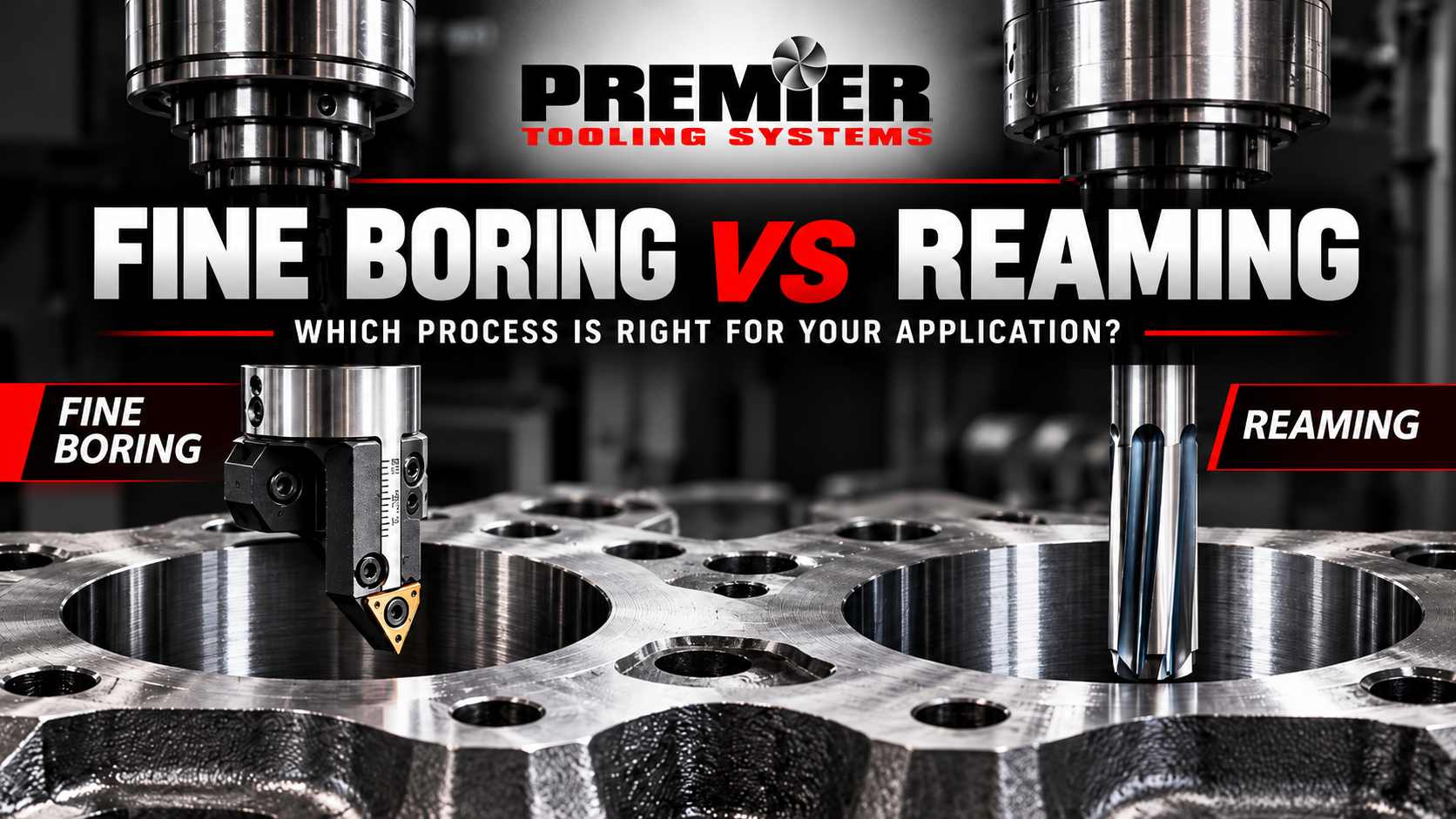
When a drilled hole needs tighter dimensional control, improved roundness or a better surface finish, manufacturers usually need an additional finishing operation.
Two common options are fine boring and reaming.
Although both processes can produce accurate finished holes, they solve different machining problems. Understanding fine boring vs reaming can help manufacturers choose a process based on hole location, diameter control, surface finish, production requirements and the condition of the existing hole.
In many applications, the decision comes down to a simple question:
Does the hole need to be corrected — or primarily finished?
That distinction can point you toward the right process.
What Is Fine Boring?
Fine boring is a precision machining operation that enlarges and finishes an existing hole using an accurately positioned cutting edge.
Unlike drilling, which creates the initial hole, boring removes material from an existing diameter and can improve its size, alignment and geometry.
ASM International describes boring as a process in which internal diameters are generated in relation to the machine spindle centerline using single-point cutting tools.
Fine boring takes that principle into a finishing operation where small, controlled amounts of material are removed.
It is particularly useful when a manufacturer needs:
- Precise diameter control
- Improved hole position
- Improved concentricity
- Correction of an imperfect pre-machined hole
- Consistent bore geometry
- Fine adjustment during setup
- Repeatability across production parts
Premier Tooling Systems' Micro-Adjustable Cartridge is designed specifically for precision boring applications where accurate diameter control and repeatable adjustment are required. It provides adjustment down to 0.01 mm on diameter and 0.005 mm on radius, allowing small corrections during setup and production.
What Is Reaming?
Reaming is also a finishing operation, but it works differently.
A reamer is normally a multi-edge rotary cutting tool that removes a relatively small amount of material from an existing hole.
The goal is generally to improve:
- Final hole diameter
- Roundness
- Surface finish
- Dimensional consistency
- Repeatability
According to ASM International's reference on reaming, reaming uses a light cutting action to improve the accuracy of a round hole while reducing surface roughness.
That makes reaming particularly effective when the hole already has acceptable location and geometry but needs to be brought to a more precise finished condition.
Fine Boring vs Reaming: The Main Difference
The biggest difference between fine boring vs reaming is not simply the type of cutting tool.
It is what each process can correct.
Fine boring can help correct the hole.
Because the boring tool is controlled by the machine spindle and cutting path, it can remove material selectively and establish the finished diameter relative to the machine's cutting axis.
Reaming primarily follows the existing hole.
A reamer is guided largely by the hole that already exists.
If the drilled or pre-machined hole is significantly out of position, angled or geometrically incorrect, reaming may improve its diameter and finish without fully correcting the underlying location error.
That is why the quality of the pre-hole is particularly important in reaming.
Fine Boring vs Reaming at a Glance
| Consideration | Fine Boring | Reaming |
|---|---|---|
| Existing hole required | Yes | Yes |
| Precision diameter finishing | Excellent | Excellent |
| Ability to correct hole position | Greater | Limited |
| Fine diameter adjustment | Strong advantage | Usually determined by reamer size |
| Surface finish | Excellent | Excellent |
| Multi-edge cutting | Usually no | Yes |
| Correcting an imperfect pre-hole | Better suited | More dependent on pre-hole quality |
| High-volume repeatability | Excellent with proper setup | Excellent with proper setup |
| Tool adjustment | Often adjustable | Usually fixed-size |
| Setup complexity | Typically higher | Often simpler |
Neither method is automatically better.
The correct choice depends on what the hole needs after the previous machining operation.
When Fine Boring Makes More Sense
Fine boring is particularly useful when precise control over the final bore geometry is required.
Imagine a drilled hole that is slightly off-center.
Running a reamer through it may improve diameter and surface finish, but the reamer can still be influenced by the existing path.
A boring operation has a greater ability to establish the finished bore relative to the machine spindle.
That makes fine boring a strong option for applications such as:
- Bearing bores
- Precision housings
- Hydraulic components
- Engine components
- Gearbox housings
- Valve bodies
- Machine components with closely controlled bore locations
- Features requiring tight relationships between multiple bores
ASM's machining reference also identifies accuracy, close-tolerance boring and vibration control as important considerations within boring operations.
When Reaming Makes More Sense
Reaming works particularly well when the pre-machined hole is already accurately located and the primary objective is improving size and surface condition.
For example, a properly drilled hole may already have acceptable location and straightness but require a more consistent final diameter.
A reamer can remove the remaining material efficiently while generating a finished surface.
Academic research published in Production Engineering describes reaming as an important process for meeting high-quality requirements in precision bore machining and notes that it can directly determine the final component quality or prepare the hole for subsequent operations. Read the reaming research from Springer Nature.
Typical reaming applications can include:
- Precision dowel holes
- Pin bores
- Bushings
- Alignment holes
- Valve components
- Automotive components
- Hydraulic components
- Production holes requiring consistent finished diameters
The Pre-Hole Matters More Than Many Shops Realize
The quality of the drilled hole affects both processes, but it is particularly important for reaming.
A reamer should not be expected to repair every error left by drilling.
If the original hole has excessive position error, taper, straightness error or inconsistent stock allowance, those conditions may influence the final result.
This is why holemaking should be considered as a sequence rather than as isolated operations.
The process might look something like:
Drill → Fine Bore → Finish
or:
Drill → Ream
or, for more demanding applications:
Drill → Bore → Ream
The correct sequence depends on the required geometry, material, tolerance and production strategy.
Premier Tooling Systems offers drilling tools and inserts for precision holemaking, including indexable drills, solid carbide drills, step drills and custom combination tooling.
Starting with a stable, accurately produced pre-hole gives the finishing operation a much better foundation.
Hole Location Can Decide the Process
One of the most useful questions when comparing fine boring vs reaming is:
Is the hole in the correct place already?
If the answer is yes, reaming may be an efficient finishing solution.
If the answer is no, boring may provide greater ability to establish the finished bore relative to the spindle and component datum.
This distinction becomes especially important where multiple bores must maintain controlled positional relationships.
Examples include:
- Transmission housings
- Pump bodies
- Hydraulic manifolds
- Engine blocks
- Bearing housings
- Precision mechanical assemblies
Producing an accurate diameter means little if the bore is accurately sized but incorrectly positioned.
Diameter Adjustment Is Another Important Difference
Fine boring systems can offer something that standard fixed-diameter reamers generally do not:
Controlled diameter adjustment at the machine.
This can be particularly valuable in production environments.
As inserts wear or manufacturing conditions change, operators may need to make very small corrections to maintain the target bore diameter.
The Premier Tooling Systems' Micro-Adjustable Cartridge provides controlled radial and axial adjustment for this purpose, making it suitable for modular boring systems and production machining where repeatable dimensional control is required.
Instead of replacing an entire tool to make a small correction, an adjustable boring system can allow the process to be dialed back into specification.
Surface Finish: Both Processes Can Perform Well
It is tempting to think of reaming as the surface-finish process and boring as primarily a dimensional process.
In reality, both can produce excellent finishes when properly applied.
Surface quality depends on many variables:
- Tool geometry
- Cutting speed
- Feed
- Workpiece material
- Machine condition
- Tool rigidity
- Runout
- Stock allowance
- Coolant delivery
- Cutting-edge condition
The machining process must therefore be evaluated as a complete system.
ASM's machining handbook discusses surface finish, cutting parameters and tool wear as interconnected elements of machining performance rather than isolated variables.
Runout Is Especially Important in Reaming
Reaming depends heavily on concentric tool rotation.
If a reamer runs off-center, individual cutting edges can carry different loads.
That can contribute to:
- Uneven cutting
- Poor hole quality
- Accelerated tool wear
- Oversized holes
- Inconsistent finish
- Reduced repeatability
This connects directly with our previous article, What Causes Tool Runout? How to Reduce It in CNC Machining.
Controlling the relationship between the spindle, holder and cutting tool is especially important when the finishing operation removes only a small amount of material.
Toolholding Can Influence the Finished Bore
Toolholding should not be treated as separate from hole quality.
A precision cutting tool cannot perform consistently if the toolholder introduces excessive runout, vibration or inconsistent clamping.
Premier Tooling Systems' Hydro-Micron hydraulic toolholding system is designed for precision applications including reaming and drilling, with hydraulic clamping that provides uniform gripping pressure and vibration damping.
For applications requiring precise tool positioning, Hydro-Preset combines hydraulic clamping with axial and radial adjustment capabilities, allowing cutting tools to be accurately preset before machining.
The holder, cutting tool and machine should therefore be considered as one system.
Rigidity Matters in Fine Boring
Fine boring introduces its own stability requirements.
A single cutting edge must remain stable as it generates the finished diameter.
Excessive tool projection or insufficient rigidity can increase deflection and vibration.
That may result in:
- Chatter
- Poor roundness
- Inconsistent diameter
- Surface-finish problems
- Reduced insert life
The boring setup should therefore be kept as short and rigid as practical while still providing the clearance required by the component.
This becomes especially important when machining deep bores or internal features with restricted access.
Don't Ignore Workholding
Not every bore problem comes from the cutting tool.
Workpiece distortion can also affect the finished result.
A component may measure correctly while clamped but change slightly after it is released if excessive workholding force has distorted the part.
This is particularly relevant with:
- Thin-wall components
- Aluminum housings
- Castings
- Lightweight structures
- Parts with interrupted sections
The machining strategy needs to consider how the component is supported as well as how the bore is cut.
NIST research into the measurement of circular features emphasizes that different hole-manufacturing processes create characteristic geometric signatures and that proper measurement strategy matters when evaluating manufactured holes. Read the NIST research on circular-feature measurement.
Production Volume Can Change the Decision
A process that makes sense for one prototype may not be the most efficient approach for 100,000 production components.
Fine boring offers excellent adjustability and process control.
Reaming can provide an efficient finishing operation once the upstream process is stable.
For higher-volume machining, manufacturers should consider:
- Cycle time
- Tool life
- Tool-change frequency
- Adjustment requirements
- Scrap risk
- Inspection frequency
- Automation
- Operator intervention
- Process capability
The fastest individual operation is not necessarily the lowest-cost process.
If a faster operation produces greater variation and requires more inspection or correction, the apparent cycle-time advantage can disappear.
Consider the Entire Holemaking Process
Choosing between fine boring vs reaming should not begin with the tool catalog.
It should begin with the finished part.
Ask:
- What is the required final diameter?
- How important is hole position?
- Does the existing hole need correction?
- What surface finish is required?
- What is the bore depth?
- How much material remains for finishing?
- Is tool adjustment required?
- How rigid is the setup?
- What is the production volume?
- How will the bore be inspected?
- Is the component likely to distort during clamping?
Those answers determine the process.
The tool comes afterward.
Fine Boring vs Reaming: Which Should You Choose?
A useful starting point is:
Choose fine boring when you need greater control over hole geometry, position and adjustable finished diameter.
Choose reaming when the existing hole is already properly located and you primarily need consistent final size and surface finish.
In demanding applications, the answer may also be both.
A boring operation can establish the geometry before a subsequent finishing operation produces the final required surface.
The best process is therefore the one that reliably delivers the finished component requirements — not simply the one with the fewest machining steps.
Precision Holemaking Is a Complete System
A finished bore is the result of much more than the final cutting tool.
Machine condition, pre-hole quality, workholding, toolholding, cutting parameters, coolant delivery and inspection all influence the result.
Premier Tooling Systems works with manufacturers to develop tooling around the complete machining process.
Our engineering services include engineering consultation, custom tool design, time studies and process optimization, process implementation and complete turnkey tooling solutions.
If you're trying to improve bore accuracy, surface finish, cycle time or process consistency, contact the Premier Tooling Systems engineering team to discuss your application.
Engineered for Precision. Built for Performance.