WE'RE HIRING! Know how to braze? Join Premier Tooling Systems. Experience with torch or induction brazing preferred. APPLY NOW!
How Hydraulic Toolholding Improves Machining Accuracy and Tool Life

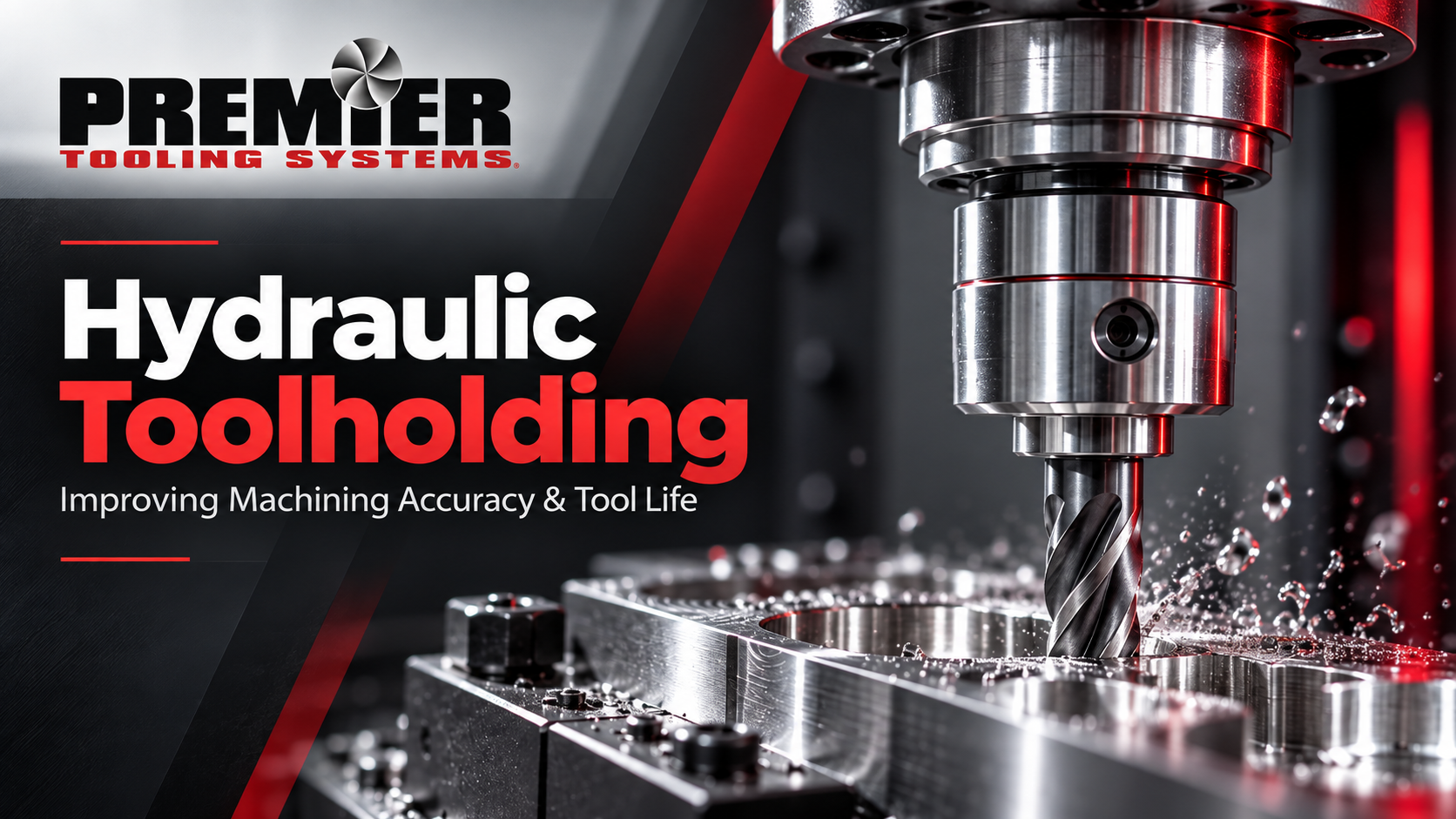
In precision machining, small variations can have a major impact on part quality.
Tool runout, vibration, inconsistent clamping and unnecessary setup time can affect surface finish, dimensional accuracy and tool life. For manufacturers working with tight tolerances, the toolholder is therefore much more than a connection between the machine spindle and the cutting tool.
A high-quality hydraulic toolholding system can help create a more stable, repeatable machining process while making tool changes faster and easier.
What Is Hydraulic Toolholding?
Hydraulic toolholders use hydraulic pressure to generate uniform clamping force around the cutting tool.
When the clamping mechanism is activated, pressure within the holder expands the clamping sleeve around the tool shank. This creates secure and concentric clamping without complicated tightening procedures.
The result is a toolholding solution designed to provide:
- High concentricity
- Reliable clamping
- Reduced runout
- Improved vibration damping
- Fast tool changes
- Repeatable tool positioning
These characteristics make hydraulic toolholding particularly useful when accuracy, repeatability and surface quality are critical.
Premier Tooling Systems offers several hydraulic configurations designed around different machining requirements, including the versatile Hydro-Micron hydraulic toolholding system and the slim-profile Hydro-Slim hydraulic toolholderfor applications where machine clearance is limited.
Why Runout Matters in Precision Machining
Runout occurs when a cutting tool does not rotate perfectly around its intended centreline.
Even a relatively small amount of runout can cause one cutting edge to remove more material than the others. The cutting load becomes uneven, which can affect both the tool and the finished component.
Excessive runout can contribute to:
- Premature tool wear
- Poor surface finishes
- Dimensional variation
- Increased vibration
- Reduced tool life
- Inconsistent part quality
Cutting Tool Engineering’s guidance on controlling runout also identifies runout as an important factor affecting hole quality, surface finish, cutting-edge load and tool life.
A precision hydraulic toolholder helps keep the cutting tool centred so its cutting edges can share the machining load more evenly.
Where even finer adjustment is required, systems such as Hydro-Zero Extension from Premier Tooling Systems combine hydraulic clamping with adjustable runout control while providing additional reach for difficult-to-access machining areas.
Improved Vibration Damping
Every machining operation generates vibration.
The challenge is controlling it.
Excessive vibration can contribute to chatter, poor surface finishes and accelerated wear on cutting tools and other components within the machining system.
One of the key characteristics of hydraulic toolholding is its ability to damp machining vibration.
Research published in Procedia CIRP examining toolholder technologies and milling performance found that hydraulic expansion toolholding demonstrated higher damping rates than the heat-shrink technology evaluated in the study. The researchers also reported improvements in surface quality, productivity and achievable tool life under their test conditions.
This damping characteristic can be particularly beneficial during operations such as:
- Milling
- Reaming
- Drilling
- Fine boring
- Grinding
- Precision finishing
For manufacturers dealing specifically with cutting-tool grinding and reconditioning, Premier Tooling Systems offers Hydro-Grind, a hydraulic holder engineered for accurate tool positioning, consistent concentricity and reduced grinding-wheel interference.
Better Surface Finish
Surface finish is influenced by many factors, including cutting speed, feed rate, tooling geometry, machine condition and workpiece material.
Toolholding stability is another important part of the equation.
When a cutting tool runs concentrically with controlled vibration, it can maintain more consistent engagement with the workpiece.
This can help manufacturers achieve:
- Cleaner machined surfaces
- More consistent finishes
- Better dimensional consistency
- Reduced secondary finishing requirements
- Greater repeatability between parts
The relationship between hydraulic clamping, runout accuracy and surface quality is also reflected in commercial hydraulic systems from other tooling manufacturers.
Longer Cutting Tool Life
Cutting tools perform best when the load is distributed as evenly as possible across their cutting edges.
Excessive runout can place additional load on individual edges. Over time, this uneven loading can result in accelerated and inconsistent wear.
Accurate tool positioning and stable clamping can therefore play an important role in maintaining predictable cutting conditions.
Improved toolholding can help reduce:
- Tool replacement frequency
- Unexpected tool failure
- Machine interruptions
- Scrap caused by worn tooling
- Unplanned production downtime
- Overall tooling costs
For high-volume manufacturing environments, even incremental improvements in cutting-tool performance can become significant when repeated across thousands of machining cycles.
Faster and More Repeatable Tool Changes
Accuracy is important, but productivity also depends on how quickly a machine can return to production.
Hydraulic toolholders provide straightforward mechanical clamping without requiring peripheral heating equipment. This can make tool installation and removal relatively quick while maintaining a repeatable clamping process.
For applications where machine space is particularly restricted, Hydro-VS from Premier Tooling Systems uses an ultra-compact hydraulic design intended to maximise machine clearance while maintaining secure clamping and hydraulic vibration damping.
Reducing unnecessary setup complexity can be especially valuable in production environments where operators perform frequent tool changes or manufacture multiple part families on the same machine.
Hydraulic Toolholding for Swiss-Type CNC Machines
Swiss-type CNC machines create their own toolholding challenges.
Turret clearance and available machine space can be limited, while accuracy and repeatability remain critical.
Premier Tooling Systems developed Hydro-Swiss Turn specifically for Swiss-type CNC lathes. Its compact construction combines hydraulic clamping with a design intended to support reliable tool changes, machining stability and precision in restricted machine spaces.
For Swiss machining operations producing high volumes of precision components, reducing toolholder size without sacrificing stability can help make better use of the available machine envelope.
Reaching Difficult Machining Areas
Not every machining challenge is caused by speed or cutting force.
Sometimes the problem is simply reaching the feature that needs to be machined.
Deep cavities, restricted features and complex component geometry can require additional tool reach. Using an unnecessarily long cutting tool, however, can introduce additional instability into the setup.
Hydro-Zero Extension is designed to provide additional machining reach while retaining hydraulic clamping and adjustable runout control. It can also be used with compatible Hydro-Sleeves to accommodate multiple cutting-tool shank sizes.
For applications where overall holder diameter rather than length creates interference, Hydro-Slim uses a narrow holder profile to improve accessibility in restricted machining areas.
Where Hydraulic Toolholding Is Used
Hydraulic toolholding systems can support a broad range of manufacturing operations, including:
- CNC milling
- Precision drilling
- Reaming
- Fine boring
- Grinding
- Precision finishing
- PCD tooling
- Swiss turning
- Automotive component manufacturing
- Aerospace machining
- Medical component manufacturing
- High-volume production machining
The correct holder depends on the cutting tool, machine, component geometry and machining requirements.
Choosing the Right Toolholding System
There is no single toolholder that is ideal for every machining operation.
Before selecting a system, manufacturers should consider:
- Machine spindle interface
- Cutting tool diameter
- Required runout
- Cutting forces
- Available machine clearance
- Tool projection
- Operating speed
- Coolant requirements
- Required surface finish
- Frequency of tool changes
- Component geometry
- Production volume
The holder should be considered as part of the entire machining system rather than as an isolated component.
Premier Tooling Systems' engineering services include engineering consultation, custom tool design, time studies and process optimisation, process implementation and turnkey tooling solutions. This allows tooling decisions to be evaluated within the wider manufacturing process rather than solely by individual tool specifications.
Precision Starts With the Toolholder
High-performance cutting tools cannot deliver their full potential without stable and accurate toolholding.
By helping control runout, damp vibration and provide repeatable clamping, hydraulic toolholding systems can contribute to better surface finishes, more consistent machining and longer, more predictable cutting-tool life.
Premier Tooling Systems provides hydraulic toolholding solutions for a wide range of CNC machining requirements, from compact Swiss turning and grinding applications to extended-reach and limited-clearance setups.
Manufacturers can explore the Premier Tooling Systems catalogue to compare available tooling solutions and brochures.
Have a machining challenge involving runout, clearance, tool life, surface finish or difficult-to-reach features? Contact Premier Tooling Systems to discuss the application with the engineering team.